

White Label vs Private Label: What’s the Difference and Which One Is Right for You?
Choosing the right manufacturing model can make launching your beauty brand faster, easier, and more cost-effective.
Launching a skincare, haircare, or cosmetics brand can be an exciting opportunity—but choosing the right production model is one of the first decisions you need to make.
Two terms you will frequently come across are White Label and Private Label. They are sometimes used interchangeably, but there can be important differences in how products are developed, customized, branded, and brought to market.
So, what is the difference between White Label and Private Label cosmetics? And more importantly, which option is right for your beauty business?
In this guide, we break down both models to help you make a more informed decision.
What Is White Label Cosmetics?
White Label cosmetics are products developed and manufactured by a supplier and then offered to multiple brands.
The manufacturer typically has an existing formulation or product range that has already been developed. Your business can select the products that fit your concept and sell them under your own brand name.
Depending on the manufacturer, you may be able to customise elements such as:
- Product packaging
- Labels and artwork
- Fragrance options
- Colour
- Product size
- Packaging format
- Selected formulation characteristics
The main advantage is speed. You are not starting the product development process from zero.
For example, a manufacturer may already have a moisturiser, facial serum, shampoo, or body lotion available. You select the product, create your branding and packaging, complete the required regulatory steps, and prepare it for launch.
What Is Private Label Cosmetics?
Private Label cosmetics generally refers to products manufactured by a third-party company and sold under your own brand.
Private label can involve a broader level of customisation than a standard white label product, depending on the supplier and project.
A private label manufacturer may work with you on:
- Product concept
- Formula modifications
- Ingredient selection
- Texture and sensory profile
- Fragrance
- Packaging
- Product claims
- Brand positioning
This gives your business more control over the final product while still allowing you to use an external manufacturing partner rather than building your own factory.
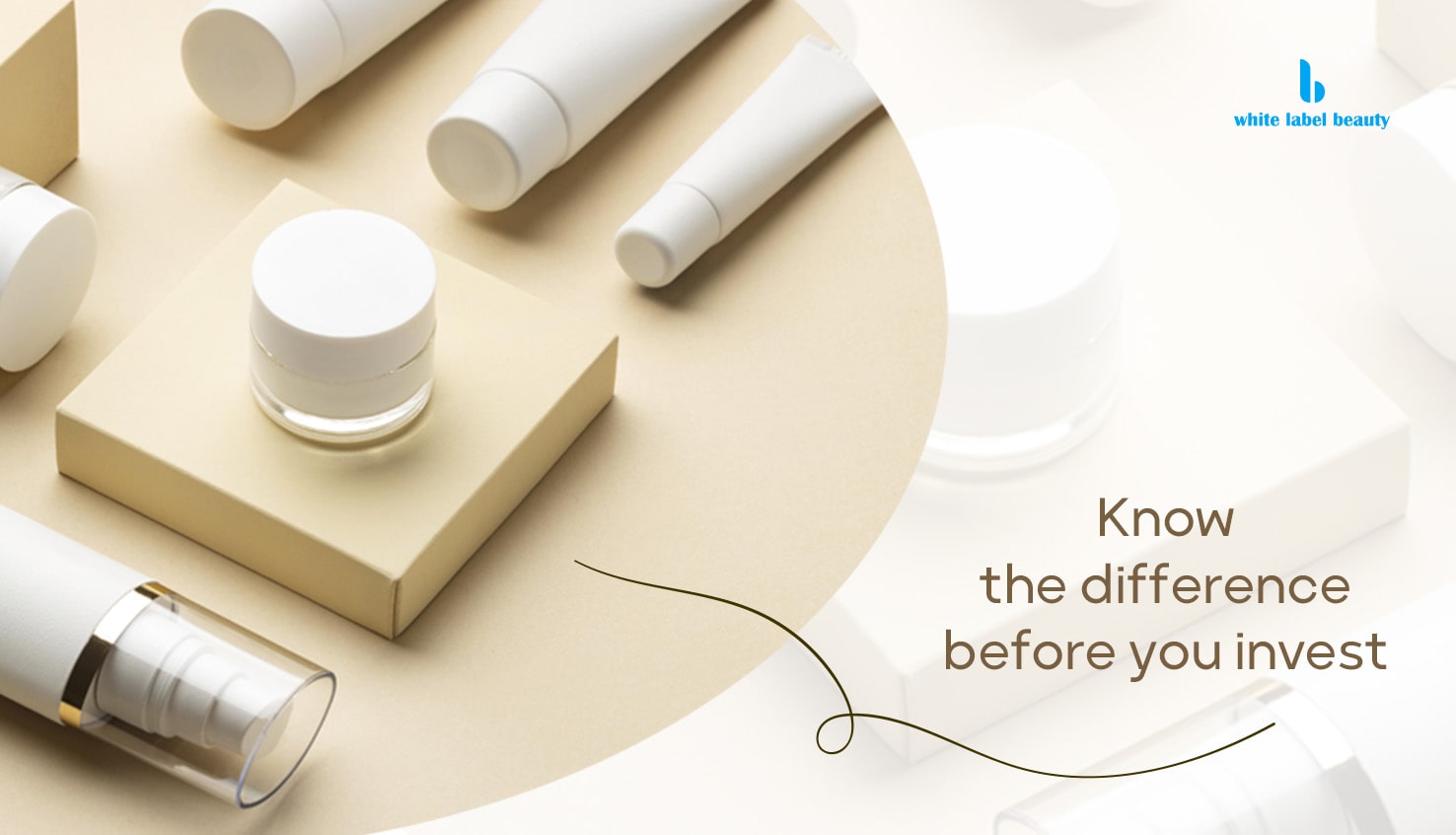
White Label vs Private Label: What’s the Difference?
The terminology is not completely standardised across the beauty industry, and some manufacturers use white label and private label differently.
However, the practical distinction is usually based on the degree of product customisation.
| Feature | White Label | Private Label |
|---|---|---|
| Existing formulation | Usually | Often |
| Customisation | Limited to moderate | Moderate to extensive |
| Formula development | Usually not required | May be possible |
| Packaging customisation | Yes | Yes |
| Brand ownership | Your brand | Your brand |
| Speed to market | Faster | Usually slower |
| Initial investment | Lower | Usually higher |
| Product differentiation | Lower | Higher |
| Suitable for | Startups & testing | Growing or established brands |
The exact services, MOQs, lead times and level of formulation customisation depend on the manufacturer.
⚡ White Label: The Faster Route to Market
One of the biggest advantages of white label skincare is speed.
Because the formulation has already been developed, you can avoid many of the early stages associated with creating a completely new product.
This can allow you to focus on:
- Brand strategy
- Packaging
- Marketing
- Sales
- Customer acquisition
White label can therefore be particularly attractive for entrepreneurs launching their first beauty brand.
White Label Is a Good Choice If You:
- Have a limited startup budget
- Want to launch quickly
- Want to test a product concept
- Don’t need a completely unique formula
- Want to start with a smaller product range
- Prefer to focus on branding and marketing
🧪 Private Label: More Control Over Your Product
Private label can be a better option when product differentiation is a major part of your business strategy.
Instead of simply selecting an existing product, you may have opportunities to develop a more tailored product concept.
For example, you might want a facial serum with a particular:
- Active ingredient combination
- Texture
- Fragrance profile
- Skin feel
- Product positioning
This additional flexibility can help an established brand create products that are more closely aligned with its target customer.
Private Label Is a Good Choice If You:
- Want greater product differentiation
- Have a specific product concept
- Already understand your target market
- Have a larger development budget
- Are prepared for a longer development timeline
- Want to build a more distinctive product portfolio
💰 Which Option Costs More?
There is no universal price difference because manufacturing costs depend on many factors.
These can include:
- Formula complexity
- Ingredients
- Packaging
- Production volume
- Testing requirements
- Minimum Order Quantity (MOQ)
- Product category
- Regulatory requirements
Generally, white label products can require less upfront investment because the formulation development stage has already been completed.
Private label or customised projects may require additional development, testing and sampling, increasing the initial investment.
For a new entrepreneur, starting with a lower-risk model can make it easier to validate demand before committing to a larger development project.
⏱ Which Is Faster: White Label or Private Label?
If speed is your priority, white label usually has the advantage.
With an existing formulation, you can move more quickly from product selection to packaging and production.
Private label projects can take longer because they may involve:
- Product briefing
- Ingredient selection
- Formulation
- Laboratory samples
- Stability and compatibility considerations
- Testing
- Formula approval
- Packaging development
- Regulatory documentation
- Manufacturing
The exact timeline varies significantly depending on the product and manufacturer.
🎨 What About Branding and Packaging?
Here’s an important point:
White label does not mean your brand has to look generic.
A professionally designed identity and packaging can transform an existing formulation into a distinctive market proposition.
You can build differentiation through:
- Brand positioning
- Packaging design
- Product naming
- Visual identity
- Customer experience
- Educational content
- Marketing strategy
For example, two brands may use similar product formats but target completely different customers through their branding and positioning.
🧴 White Label vs Private Label: Which Is Better for Skincare Startups?
For many first-time entrepreneurs, white label can be a practical starting point.
You can launch a small collection, test customer response, learn what sells, and then invest in more customised products as your business grows.
A possible growth strategy could look like this:
Stage 1 → White Label
Launch quickly with proven product concepts.
↓
Stage 2 → Market Testing
Collect customer feedback and identify your best-performing products.
↓
Stage 3 → Product Development
Introduce more customised or exclusive formulations.
↓
Stage 4 → Brand Expansion
Build a differentiated product portfolio around your strongest categories.
This approach allows a brand to grow without necessarily making a large development investment from day one.
🔍 Questions to Ask a White Label or Private Label Manufacturer
Before choosing a manufacturing partner, don’t only ask about price.
Consider asking:
1. What is your MOQ?
Understanding the Minimum Order Quantity helps you calculate your initial investment and inventory requirements.
2. Can the formulation be customised?
If differentiation is important to you, clarify exactly what can and cannot be changed.
3. What testing is available?
Ask about relevant safety, stability, microbiological and packaging compatibility testing.
4. Who handles regulatory documentation?
For UK cosmetics, clarify responsibilities around the Responsible Person, CPSR, Product Information File and UK SCPN notification.
5. What packaging options are available?
Packaging can have a major impact on your brand positioning and customer experience.
6. Can production scale with my business?
Your manufacturing partner should ideally be able to support you as your order volumes increase.
🇬🇧 What About UK Cosmetic Compliance?
Whether you choose White Label or Private Label cosmetics, the finished product must comply with the applicable UK cosmetic requirements before being placed on the UK market.
Depending on the product and circumstances, this can include requirements relating to:
- Product safety
- Cosmetic Product Safety Report (CPSR)
- Product Information File (PIF)
- Responsible Person
- UK SCPN notification
- Ingredient labelling
- Cosmetic claims
- Good Manufacturing Practice (GMP)
Choosing a manufacturing partner with strong regulatory knowledge can make the process significantly easier.
🎯 So, Which One Is Right for You?
There is no single answer for every beauty entrepreneur.
Choose White Label if you want:
⚡ Faster market entry
💰 Lower initial development costs
🧴 Ready-developed products
📦 A simpler launch process
🧪 Less formulation development
🚀 A practical way to test your business idea
Choose Private Label if you want:
🧬 Greater product customisation
🎯 Stronger differentiation
🧪 More control over formulation
🏆 A distinctive product proposition
📈 A long-term product development strategy
Ultimately, the right choice depends on your budget, timeline, target market, product concept and growth strategy.
Final Thoughts: White Label or Private Label?
White Label and Private Label are both valuable routes for launching a beauty brand.
If your priority is speed, simplicity and reducing the initial development investment, white label can be an excellent starting point.
If your priority is creating a more differentiated product with greater control over formulation, private label or custom formulation may be more appropriate.
The most important decision isn’t simply choosing between two labels. It’s finding a reliable manufacturing partner that understands your brand, target market, product requirements and regulatory responsibilities.
At White Label Beauty, we support entrepreneurs and growing beauty brands with product development, manufacturing, packaging and private label solutions designed around their individual goals.
Ready to turn your beauty idea into a real product?
👉 Contact our team today and let’s discuss the right manufacturing route for your brand.